Travel-inspired jewelry is jewelry that uses places, maps, landmarks, or travel mementos to express a person’s connection to a journey or destination. People wear it to keep meaningful experiences close, mark milestones, signal identity, and spark conversation. Its appeal makes sense in a world where travel is widespread: the United Nations World Tourism Organization reported about 1.4 billion international tourist arrivals in 2024, roughly 99% of the 2019 level. From a simple map pendant to a charm collected on a trip, these pieces turn travel memories into wearable reminders.
Travel-inspired jewelry expresses memory and personal meaning
Travel-inspired jewelry is a broad category of adornment whose design or materials refer to travel. The reference may be literal, such as a world-map engraving, or personal, such as a stone bought in a place associated with a major life event. The Smithsonian’s National Museum of American History describes personal objects as potential carriers of memory and meaning; jewelry can function similarly because it is portable, visible, and often kept close to the body.
Common forms include destination pendants, map and coordinate jewelry, landmark motifs, travel charms, and pieces made with locally sourced materials. They differ in how explicitly they identify a place, but share a central purpose: connecting an object with an experience. This helps explain why travel jewelry is not only a fashion choice; it can also serve as a personal record.
Memory keepsakes and emotional connection
A travel keepsake is an object retained to recall a particular experience. Jewelry makes an especially portable keepsake: a wearer can encounter it throughout the day rather than storing it in a drawer. A pendant engraved with a trip date, for example, may recall a first solo journey, a family holiday, or a place where someone lived.
Psychological research on autobiographical memory finds that reminders in the environment can cue recollection. A piece of jewelry is not a guarantee of a particular emotional effect, but its repeated visibility can help prompt memories and personal storytelling. Unlike a photograph, it also becomes part of the wearer’s everyday appearance, allowing remembrance to accompany routine activities.
Identity, belonging, and self-expression
Travel jewelry can communicate identity by making a meaningful connection to a place visible. A person may wear a symbol of their birthplace, an adopted home, family heritage, or a destination that changed their outlook. Sociologist Erving Goffman’s work on self-presentation describes how people use signs and objects to shape how they are understood by others; jewelry can be one such sign, though its meaning depends on the wearer and the audience.
This form of expression need not be obvious. Coordinates may be legible only to the wearer, while a recognizable landmark can invite questions. In either case, the object gives its owner control over how much of a travel story to share.
Conversation and social connection
A distinctive travel motif can act as a conversation starter. Someone who recognizes a city skyline, regional craft style, or national symbol may ask about its origin, creating an opening to exchange stories. The jewelry does not need to be expensive or elaborate: a small charm can carry a clear personal association.
This social function connects private memory with shared experience. A piece may prompt a conversation about a destination, but it can also reveal differences in how people interpret the same place. The wearer’s account gives the object meaning beyond its design.
Travel-inspired jewelry records places and journeys
A travel record is any representation of a journey, whether written, visual, or material. Travel-inspired jewelry can act as a compact, informal record by associating a person with a location, route, or moment. Unlike a detailed travel journal, it usually condenses an experience into a symbol or a few identifying details.
The United Nations World Tourism Organization’s reported 1.4 billion international tourist arrivals in 2024 show the scale of contemporary cross-border travel, although arrivals count trips rather than unique travelers. The figure helps explain the broad market for destination-associated objects, but it does not establish why any individual buys or wears jewelry. Personal accounts and the design itself are more useful for understanding those motivations.
Map, location, and coordinate jewelry
Map jewelry depicts a country, region, island, or route, while coordinate jewelry uses latitude and longitude to identify a location. These designs turn geography into a wearable shorthand. Coordinates may mark a birthplace, wedding location, first meeting, or favorite destination without displaying the place name to everyone who sees the piece.
Their appeal lies in the balance between precision and privacy. A map outline can be broadly recognizable, whereas coordinates often require explanation or a digital lookup. Both can make an otherwise abstract location personally significant.
Landmark and destination motifs
Landmark jewelry represents a recognizable building, monument, natural feature, or city symbol. Examples might include a miniature Eiffel Tower, a mountain silhouette, or a skyline associated with a particular trip. These motifs connect a personal memory to a place that may also have public or cultural significance.
Because famous imagery can be simplified for jewelry, accuracy and context matter. A landmark is not always a complete representation of a destination or its residents. Thoughtful designs can acknowledge local identity rather than treating a place merely as a souvenir image.
Charms collected across multiple journeys
A travel charm is a small decorative element added to a bracelet, necklace, or other piece to represent a place or event. Collecting charms over time lets the jewelry grow into a chronological or thematic record: one charm might mark a first overseas trip, another a national park, and a third a family reunion.
The format also makes the wearer’s travel story adaptable. Charms can be added, rearranged, or passed down, allowing the object to change as its owner’s experiences accumulate. A chart could compare these forms by how directly they identify a location: landmark motifs are often immediately recognizable, map designs identify a region, coordinates specify a point, and charms may rely most on the wearer’s own story.
Travel-inspired jewelry marks milestones and transitions
A milestone is an event that a person considers important in their life story. Travel can mark transitions such as graduation, a new job, retirement, recovery, or a move to another country. Jewelry associated with the journey can give that transition a durable, tangible reminder.
This use differs from collecting a generic souvenir: the meaning is anchored in what the journey represented to the wearer. A ring bought after completing a long trek, for instance, may stand for persistence as much as for the route itself.
Celebrations, relationships, and shared journeys
Travel jewelry can commemorate a shared event, such as a honeymoon, anniversary trip, or journey taken with friends. Matching or complementary pieces make the connection visible, while a single item can serve as a private reminder of the people who were present.
The meaning can remain important after the trip ends. A place-associated pendant may recall a relationship or stage of life, even when the wearer has not returned to that destination. In this way, jewelry links geography with social memory.
Change, independence, and personal achievement
Some people choose travel jewelry to recognize a challenge they met or a period of change. A journey may symbolize independence, confidence, or the decision to begin again. The object’s value then comes less from the material and more from the story attached to it.
A useful example is a traveler who buys a modest piece after completing a first solo trip. The jewelry can function as a reminder of the decisions and skills that made the journey possible, rather than as proof of where the traveler has been.
Travel-inspired jewelry connects design with local culture
Travel-inspired jewelry may be made in, purchased in, or designed around a destination. When it draws on local materials or craft traditions, it can connect the wearer to the people and skills behind the object. The World Tourism Organization’s work on sustainable tourism emphasizes tourism’s potential social and economic benefits alongside the need to manage its impacts. That principle is relevant to souvenir jewelry: the source and production conditions matter as much as the destination motif.
Local craft and material provenance
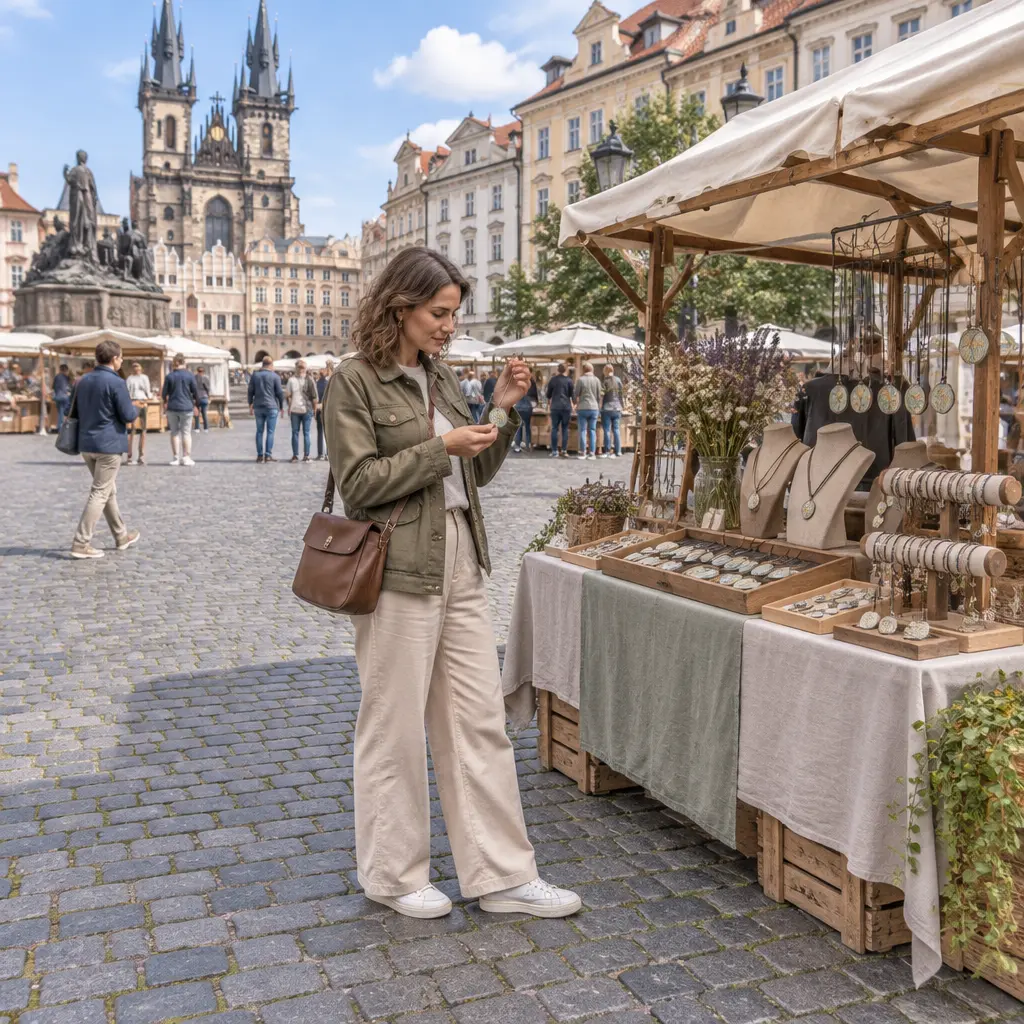
Provenance is information about an object’s origin and history. Jewelry with clear provenance may identify its maker, the place where it was produced, and the materials used. Buying directly from a local artisan or a reputable cooperative can make that connection more concrete, though shoppers should not assume that every item sold at a destination was made there.
The United Nations Educational, Scientific and Cultural Organization recognizes traditional craftsmanship as an area of intangible cultural heritage. This highlights why craft knowledge deserves respect and fair recognition. Buyers can ask who made a piece, whether the design is locally rooted, and how the maker benefits from the sale.
Respectful design and cultural context
Cultural symbols can have meanings beyond decoration, including religious, ceremonial, or community-specific significance. A design that looks like a simple motif to a visitor may carry a specific identity or history for the people associated with it. Learning the context before purchasing or wearing such a piece helps avoid treating cultural heritage as an interchangeable travel accessory.
A respectful choice favors transparent makers, accurate descriptions, and designs offered with appropriate permission. This is particularly important when a motif is associated with a living Indigenous community or a sacred tradition.
Choosing travel-inspired jewelry thoughtfully
The best travel-inspired piece is one whose design, quality, and origin suit the wearer’s reasons for choosing it. Buyers can balance emotional value with practical considerations such as durability, comfort, maintenance, and ethical sourcing.
Match the design to the memory
Choose a form that reflects how the journey matters. Coordinates can suit a private, precise memory; a landmark can make a destination immediately recognizable; and charms can accommodate many trips. Engraving a date or short phrase can add context without making the piece visually complicated.
Consider durability and daily wear
Materials and construction determine whether jewelry can withstand frequent use. Buyers should check metal composition, clasp security, gemstone settings, and care instructions, especially if the piece will be worn while traveling. A delicate souvenir may be meaningful but better suited to occasional wear than outdoor activities or swimming.
Check origin, materials, and maker claims
Clear information about materials and production helps buyers make informed decisions. Ask whether a piece is locally made, whether its materials are recycled or newly mined, and whether claims about artisan production can be verified. These questions support more responsible purchasing and help preserve the story behind the jewelry.
Conclusion: Travel-inspired jewelry makes journeys wearable
People wear travel-inspired jewelry to preserve memories, express identity, invite conversation, mark life transitions, and maintain a connection to places and people. Map designs, coordinates, landmark motifs, and collected charms each record a journey in a different way. When a piece draws on local craft, its meaning also depends on provenance, cultural context, and fair recognition of makers.
With international tourist arrivals reaching about 1.4 billion in 2024, travel continues to shape many people’s lives, but the meaning of a jewelry keepsake remains individual. Choose a piece for the story it genuinely represents, learn how and where it was made, and consider supporting transparent local makers. A thoughtful piece can be both a personal memento and a reminder to engage respectfully with the places that inspire it.
Sources: United Nations World Tourism Organization, World Tourism Barometer, January 2025, https://www.unwto.org/news/international-tourism-recovers-pre-pandemic-levels-in-2024; Smithsonian National Museum of American History, “Object Project,” https://americanhistory.si.edu/explore/projects/object-project; Goffman, Erving, The Presentation of Self in Everyday Life, 1959, https://www.penguinrandomhouse.com/books/292812/the-presentation-of-self-in-everyday-life-by-erving-goffman/; United Nations Educational, Scientific and Cultural Organization, “Traditional craftsmanship,” https://ich.unesco.org/en/traditional-craftsmanship-00057; United Nations World Tourism Organization, “Sustainable Development,” https://www.unwto.org/sustainable-development