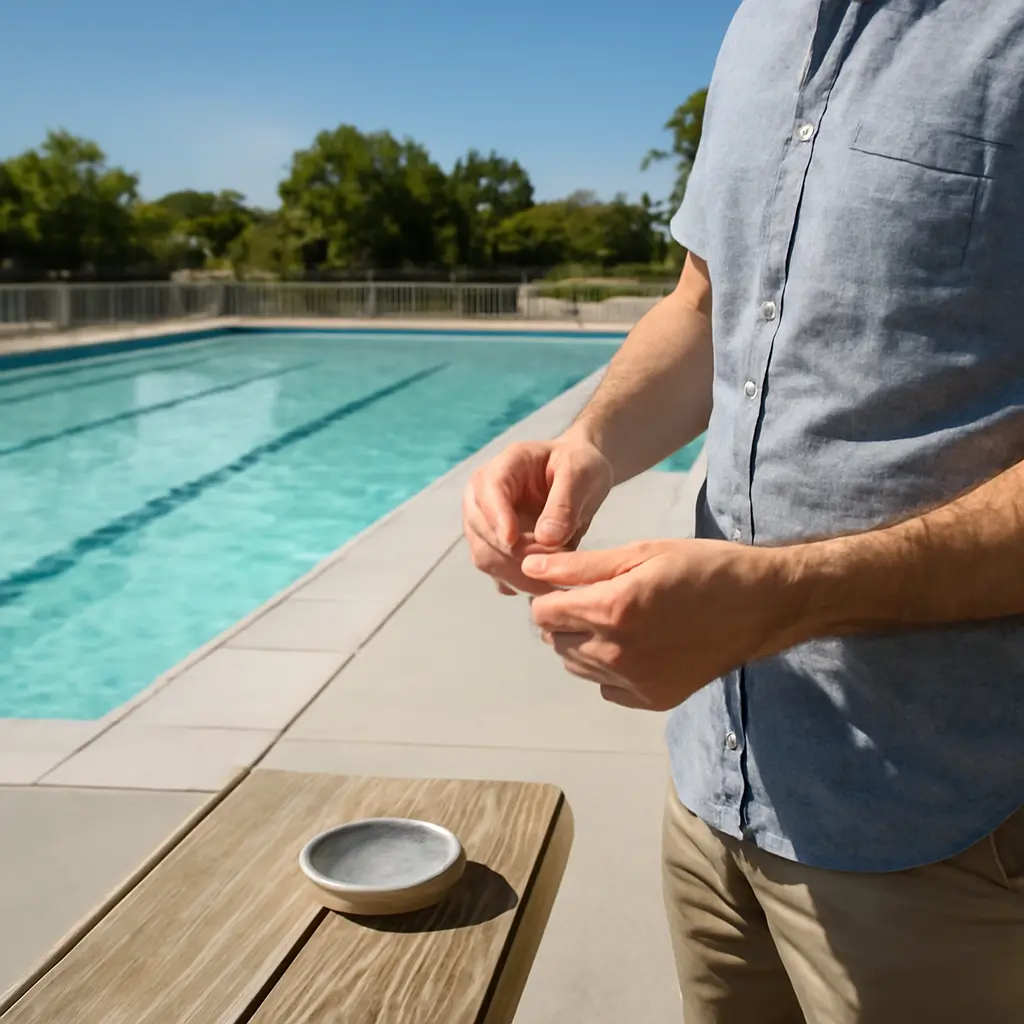
Chlorine is a powerful disinfectant, but it can also damage jewelry—especially when exposure is frequent or prolonged. In pools and hot tubs, chlorine-containing water can tarnish silver, weaken some gold alloys, and corrode vulnerable metals and settings. The risk depends on the jewelry’s metal, construction, and exposure, so the safest habit is simple: remove jewelry before swimming, soaking, or using household chlorine bleach, then rinse and dry it if accidental contact occurs.
Chlorine exposure and jewelry damage
Chlorine is an element used in disinfectants and water treatment; in pools, it is present mainly as dissolved chlorine-based disinfectants that form active sanitizing compounds in water. The Centers for Disease Control and Prevention (CDC) says properly operated pools maintain free chlorine within a recommended range that commonly starts at 1 part per million (ppm), with at least 3 ppm recommended for hot tubs. Those levels are intended to control germs, not to guarantee that jewelry will remain unaffected.
Jewelry damage is a matter of exposure, not a guaranteed result of one brief swim. Repeated contact, warm water, and chemical residues can increase the opportunity for corrosion or surface change. The Gemological Institute of America (GIA) advises removing jewelry before swimming because chlorine can damage metals and may affect gemstones or jewelry components. Pool water chemistry varies, so there is no single exposure time that can reliably predict damage.
How chlorine can affect jewelry materials
Corrosion is the deterioration of a material through chemical reactions with its environment. Chlorine-containing water can react with metals in jewelry alloys, particularly when exposure is repeated or the surface has scratches, porous areas, or crevices. Chloride salts and other pool chemicals may also leave deposits that dull a finish. The visible result can range from loss of shine and discoloration to pitting or weakening, depending on the alloy and conditions.
An alloy is a mixture of metals. Jewelry described as gold or silver is often not pure: 14-karat gold, for example, contains 14 parts gold out of 24, with the remaining portion made up of other metals. Those added metals help change hardness and color, but they can also influence how a piece responds to chemicals. The precise response depends on the complete alloy and the item’s construction.
Why swimming and hot tubs raise the concern
Swimming and hot-tub use expose jewelry to treated water across its surface and can trap water beneath stones, behind settings, or inside hollow designs. Hot tubs generally operate at higher temperatures than swimming pools, and the CDC recommends keeping hot-tub water at or below 104°F (40°C). Higher temperature is one reason to be cautious, but heat alone does not predict damage: water chemistry, exposure frequency, and jewelry materials also matter.
A practical example is a ring worn during repeated pool visits. Even if it looks unchanged after one swim, continued exposure may dull its finish or affect vulnerable alloy components over time. A single rinse after swimming cannot reverse corrosion that has already occurred, which is why prevention is more reliable than trying to clean damage later.
Jewelry materials vary in chlorine resistance
Chlorine resistance means how well a material withstands contact with chlorine-containing substances without undesirable chemical or physical change. It is not an all-or-nothing label: an item’s metal, plating, solder, setting, and condition all influence its vulnerability. The GIA’s general advice to remove jewelry before swimming applies broadly because a gemstone may be secure in one design and vulnerable in another.
Gold and gold alloys
Gold jewelry is usually alloyed with other metals to make it durable enough for everyday wear. The World Gold Council explains that karat measures the proportion of gold in an alloy out of 24 parts: 18-karat gold is 18 parts gold, while 14-karat gold is 14 parts gold. Because the remaining metals differ among alloys, there is no universal chlorine response for every piece of gold jewelry. Repeated pool exposure can damage alloy components, so removing gold jewelry before swimming is a prudent precaution.
Silver, plated jewelry, and base metals
Sterling silver is an alloy that contains at least 92.5% silver, according to the Federal Trade Commission’s Jewelry Guides. Silver can tarnish through chemical reactions with its surroundings, and chlorine exposure may contribute to surface discoloration or damage. Plated jewelry adds another concern: a thin surface layer can wear away through abrasion or chemical exposure, revealing the metal underneath. Base-metal pieces and costume jewelry may also have coatings, solders, or components that react differently from the visible surface.
Gemstones, settings, and adhesives
A gemstone’s durability is not the only consideration. The setting—the metal structure that holds a stone—may be more vulnerable than the gem itself, while adhesives, coatings, and treatments can introduce additional sensitivities. GIA recommends considering a gem’s hardness, toughness, and stability as distinct properties: hardness describes resistance to scratching, toughness concerns resistance to breaking or chipping, and stability relates to sensitivity to heat, light, or chemicals. Because jewelry designs vary, avoid assuming a stone is safe in pool water just because the gemstone is commonly worn every day.
Ways to prevent chlorine damage
Prevention is easier than repairing a corroded surface or a weakened setting. Removing jewelry before exposure avoids uncertainty about alloy composition, water chemistry, and how long the piece will remain wet. The same precaution applies to household bleach, which is a stronger and more concentrated chlorine-containing product than properly maintained pool water.
Before swimming or cleaning
- Remove rings, necklaces, bracelets, watches, and earrings before entering pools or hot tubs.
- Take jewelry off before handling bleach or chlorine-based cleaners; follow the product label and avoid mixing cleaning products.
- Store jewelry in a dry, secure place away from pool edges and drains.
- If an item must remain on, check the manufacturer’s care instructions rather than assuming the material is chlorine-proof.
After accidental exposure
If jewelry contacts pool water, rinse it promptly with clean, fresh water and dry it gently with a soft, lint-free cloth. Avoid aggressive polishing or household chemicals, which may worsen damage or harm plating and gemstones. If a piece looks discolored, feels loose, or has a stone that moves, stop wearing it and ask a qualified jeweler to inspect it. Cleaning can remove residues, but it cannot restore metal that has been etched, worn away, or structurally weakened.
Conclusion: protect jewelry by limiting chlorine exposure
Chlorine-containing water can dull, tarnish, or corrode jewelry, with the outcome shaped by exposure and the piece’s alloys, plating, settings, and gemstones. Pool and hot-tub sanitation levels are designed for water safety, not jewelry preservation; even a brief swim may be followed by repeated exposures that add up. Remove jewelry before swimming, soaking, or using bleach, and rinse and dry it if contact happens. For valuable or damaged pieces, ask a professional jeweler for material-specific care advice.
Sources: Centers for Disease Control and Prevention, “Home Pool and Hot Tub Water Treatment and Testing,” https://www.cdc.gov/healthy-swimming/about/home-pool-and-hot-tub-water-treatment-and-testing.html; Centers for Disease Control and Prevention, “About Healthy and Safe Swimming,” https://www.cdc.gov/healthy-swimming/about/index.html; Gemological Institute of America, “Jewelry Care: How to Clean and Store Your Jewelry,” https://www.gia.edu/gia-news-research/how-to-clean-jewelry; Gemological Institute of America, “Gemstone Durability,” https://www.gia.edu/gem-gemstone-durability; World Gold Council, “Gold Jewellery,” https://www.gold.org/about-gold/about-gold-jewellery; Federal Trade Commission, “Guides for the Jewelry, Precious Metals, and Pewter Industries,” https://www.ftc.gov/legal-library/browse/rules/guides-jewelry-precious-metals-pewter-industries