A handmade piece of jewelry can be more than an ornament: it can hold a person’s story in a form they can touch and wear. Handmade jewelry is jewelry shaped, assembled, or finished through individual craft rather than produced entirely by automated mass manufacturing. Its lasting emotional value often comes from the combination of personal meaning, visible workmanship, and the moment it commemorates. A custom birthstone pendant, a repaired family ring, or a bracelet made from a loved one’s materials can turn memory into an everyday keepsake. Research on autobiographical memory and possessions helps explain why objects can cue recollection, while U.S. survey data on gifting and consumer spending show how jewelry remains part of important life events. The sections below examine craftsmanship, personalization, materials, memory, and practical ways to make a keepsake endure.
Handmade Jewelry’s Personal Meaning
Handmade jewelry’s personal meaning is the significance a wearer attaches to a piece because of its origin, design, materials, or connection to a person or event. There is no single universal definition of “meaningful jewelry”; in practice, it is jewelry that acts as a personal symbol or reminder. The American Psychological Association describes autobiographical memory as memory for events and experiences from a person’s own life. A meaningful object can serve as a cue that helps bring those memories to mind, although the object does not guarantee that a memory will remain unchanged or perfectly accurate.
The distinction between handmade and keepsake jewelry is useful: “handmade” describes how a piece is made, while “keepsake” describes the role it plays for its owner. A handmade ring may be purely decorative; a mass-produced locket can become a cherished keepsake. The strongest sentimental pieces often combine both qualities: an individual craft process and a story the wearer recognizes as their own.
Craftsmanship Makes the Object Feel Particular
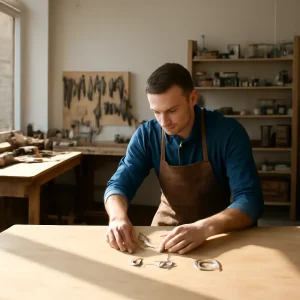
Craftsmanship is the skilled work involved in designing, forming, joining, setting, and finishing jewelry. Hand fabrication may include sawing, forging, soldering, stone setting, and polishing; other makers use casting or combine handwork with digital design. Small variations in texture or form can make a piece feel individual, but handmade does not automatically mean stronger or more durable. Quality depends on sound construction, appropriate materials, secure settings, and careful finishing.
That visible labor can add to a piece’s story: the wearer may know who made it, how it was formed, or why a particular detail was chosen. The U.S. Bureau of Labor Statistics classifies jewelers and precious-stone and metal workers as skilled craft occupations, reflecting the specialized techniques behind jewelry production. For a lasting gift, ask the maker about the construction method, care requirements, and repair options, rather than relying on “handmade” as a guarantee of longevity.
Personalization Turns Details into Symbols
Personalization is the adaptation of a design to a specific person, relationship, or occasion. It can be literal, such as an engraved name, date, or handwriting, or symbolic, such as a birthstone, a chosen color, a meaningful shape, or coordinates associated with a place. Initials and dates make a message explicit; less obvious motifs can create a private meaning shared only by the maker and wearer.
A useful example is a pendant engraved with a short phrase in a family member’s handwriting. Its value lies not only in the metal but in the preserved visual trace of a familiar person. Before ordering, confirm spelling, engraving placement, character limits, and whether the maker can reproduce the source image accurately. Personalization works best when it reflects the recipient’s preferences rather than assuming that every person wants a name or date displayed.
Memory Cues in Keepsake Jewelry
Memory cues are sights, sounds, smells, or objects that prompt recollection. Jewelry can become a cue through repeated association: a person wears a ring during a major life transition, receives a pendant from a relative, or keeps a charm connected to a shared trip. Psychologist Susan Clayton’s research on people’s relationships with meaningful places and possessions illustrates a broader point: objects can become connected to identity and personal history. This does not mean that a piece contains a memory; rather, the wearer’s experiences give the object its associations.
The U.S. National Institute on Aging notes that remembering involves processes such as encoding, storage, and retrieval. A keepsake may support retrieval by providing a familiar sensory prompt, but individual memory varies, and jewelry is not a substitute for photographs, written records, or conversation. Its distinctive contribution is portability: unlike many mementos, a wearable object can accompany someone through ordinary routines.
Milestone Jewelry Marks a Moment
Milestone jewelry is a piece associated with a significant life event, such as a birth, graduation, wedding, anniversary, or personal achievement. The object helps mark the occasion and can later recall the people and circumstances surrounding it. U.S. consumer spending data from the Bureau of Labor Statistics’ Consumer Expenditure Surveys track spending categories that include jewelry, while the National Retail Federation’s seasonal surveys regularly report jewelry among popular gift choices. These measures show that jewelry participates in gift-giving, though they do not measure how emotionally meaningful an individual item becomes.
For example, a parent might give a handmade bracelet to mark a child’s graduation, adding a small motif tied to the graduate’s interests. The significance is strengthened by the story told with the gift and by the recipient’s own interpretation. A maker can help translate that story into a durable design without making the piece overly literal.
Inherited and Remade Jewelry Connects Generations
Inherited jewelry is jewelry passed from one person to another, often within a family; remade jewelry incorporates an older piece or its materials into a new design. These forms can connect generations while allowing a recipient to wear an item in a way that suits their life. A jeweler may reset a stone, resize a ring, or incorporate gold from a family object, but the feasibility depends on the item’s condition, metal composition, and the owner’s wishes.
A practical case is a family ring whose stone is retained while the setting is redesigned for everyday wear. Before alteration, document the original piece with photographs and discuss whether preserving its original form matters to family members. Reusing materials can be meaningful, but precious metals and gemstones may require testing and expert assessment; not every inherited item can be safely or economically remade.
Materials and Ethical Choices Preserve the Story
Material choice affects a piece’s appearance, maintenance, cost, and sourcing story. Common options include gold, silver, platinum, gemstones, glass, enamel, wood, and recycled or reclaimed materials. Each has different properties: sterling silver can tarnish, softer metals can scratch or deform, and some stones are more vulnerable to impact or chemicals than others. The Gemological Institute of America advises consumers to consider a gemstone’s durability and care needs, especially when selecting a stone for frequent wear.
Ethical sourcing is another part of the object’s provenance: the account of where its materials came from and how they were obtained. The Organisation for Economic Co-operation and Development publishes guidance for responsible mineral supply chains, including due diligence intended to identify and address risks. Buyers can ask makers whether metals are recycled, how gemstones are sourced, and what documentation is available. Clear answers support informed choices, but claims such as “ethical” or “sustainable” should be evaluated in relation to the specific material and supply chain.
Recycled Metals and Traceable Gemstones
Recycled metal is metal recovered from existing jewelry, industrial scrap, or other sources and refined for reuse. It can reduce demand for newly mined material, although its overall environmental impact depends on collection, refining, energy use, and the wider supply chain. Traceable gemstones are stones for which a seller provides information about origin or chain of custody; the level of verification varies, so buyers should ask what the claim specifically means.
A maker who uses a customer’s old gold or a documented recycled alloy can add material continuity to a keepsake. Still, recycled does not automatically mean impact-free, and origin information is not always independently certified. Ask for plain-language details about the source, any certification, and whether the material can be identified on an invoice or care record.
Durability and Repair Help a Keepsake Last
Durability is a material’s ability to resist wear, damage, and deterioration in its intended use. For jewelry, practical durability depends on more than a gemstone’s hardness: setting design, thickness, solder joints, exposure to chemicals, and the wearer’s habits all matter. A delicate chain may be unsuitable for constant wear, while a raised stone setting may catch on clothing. A jeweler can recommend a design based on whether the piece is intended for daily use or occasional wear.
Repairability is the ability to maintain or restore a piece rather than discard it. Before purchase, ask whether the maker offers resizing, stone resetting, chain repair, or refinishing, and whether replacement parts or design records will be available. Store jewelry separately, remove it for activities that risk impact or chemical exposure, and follow care guidance suited to the particular metal and stone. Maintenance does not erase the object’s history; it helps the object remain part of it.
Choosing Handmade Jewelry as a Lasting Keepsake
Choosing a keepsake begins with the recipient and the story, not the trend. Consider whether the person prefers subtle or expressive designs, what they already wear, and whether the piece needs to withstand daily use. Then discuss the intended meaning with the maker and agree on materials, measurements, budget, delivery timing, and care. A concise design brief can prevent misunderstandings and make custom work more personal.
- Identify the memory, person, or milestone the piece should represent.
- Choose a form and materials suited to the wearer’s style and routine.
- Ask the maker about construction, sourcing, care, repairs, and production timeline.
- Review sketches, inscriptions, and sizing before approving the final design.
- Include a note explaining the story and keep any certificates, receipts, or care instructions with it.
The note matters because meaning is often carried through storytelling as much as through design. Explain why a particular stone, material, or symbol was chosen, while leaving room for the recipient to develop their own relationship with the piece. A handmade object becomes a lasting memory not simply because it is made by hand, but because it joins thoughtful design with personal history, responsible care, and continued use.
Conclusion
Handmade jewelry becomes a memory someone keeps when craftsmanship, personalization, materials, and lived experience meet in one wearable object. Craft can make a piece distinctive; inscriptions and symbols can express a story; milestone and inherited jewelry can link people across time; and thoughtful sourcing, durability, and repair can help preserve the object. Research on autobiographical memory helps explain why a familiar possession may prompt recollection, while consumer surveys confirm jewelry’s continuing role in gifting without measuring the private meaning behind each piece.
If you are commissioning a keepsake, start with the story you want it to carry, ask the maker direct questions about materials and construction, and choose a design the recipient will genuinely wear. For further reading, explore the Gemological Institute of America’s gemstone-care guidance, the OECD’s responsible-sourcing guidance, and the National Institute on Aging’s information about memory.
Sources: American Psychological Association, APA Dictionary of Psychology, “autobiographical memory,” https://dictionary.apa.org/autobiographical-memory; U.S. National Institute on Aging, “How the Aging Brain Affects Thinking,” https://www.nia.nih.gov/health/brain-health/how-aging-brain-affects-thinking; Susan Clayton, “The Role of Perceived Quality of the Environment in the Health of People,” The Psychologist, 2007, https://thepsychologist.bps.org.uk/volume-20/edition-4/role-perceived-quality-environment-health-people; U.S. Bureau of Labor Statistics, “Jewelers and Precious Stone and Metal Workers,” Occupational Outlook Handbook, https://www.bls.gov/ooh/production/jewelers-and-precious-stone-and-metal-workers.htm; U.S. Bureau of Labor Statistics, Consumer Expenditure Surveys, https://www.bls.gov/cex/; National Retail Federation, Holiday Consumer Survey, https://nrf.com/research/holiday-consumer-survey; Gemological Institute of America, “Gemstone Care,” https://www.gia.edu/gem-care-cleaning; Organisation for Economic Co-operation and Development, OECD Due Diligence Guidance for Responsible Supply Chains of Minerals from Conflict-Affected and High-Risk Areas, https://www.oecd.org/en/publications/oecd-due-diligence-guidance-for-responsible-supply-chains-of-minerals-from-conflict-affected-and-high-risk-areas_9789264252479-en.html.